
This program trains students in the most critical aspects of business management. Understand and refine your understanding of the tools needed in business creation and management through financial concepts, marketing and operations.
1x
Accreditation
Barcelona Executive Business School
Online
On Campus

Language
English or Spanish
English
Duration
6 Months
6 month
Credits
30 ECTS
30 ECTS

Acquire the skills and tools necessary to innovate and establish your own businesses with direct, practical, and effective training. Work with real-world cases, participate in company visits, and apply your newfound knowledge in practice.
1x
Accreditation
Barcelona Executive Business School
Online
On Campus
Language
English or Spanish
English
Duration
6 Months
6 Month
Credits
30 ECTS
30 ECTS

A focus on the managerial, technical and strategic aspects of the supply chain. Acquire the knowledge to address relevant issues in the industrial sector and devise modern solutions for the logistics and supply chain sector.
1x
Accreditation
Barcelona Executive Business School
Online
On Campus
Language
English
English
Duration
6 Months
6 Month
Credits
30 ECTS
30 ECTS

Project managers are highly sought-after professionals, as they organize and steer ideas towards business success. This postgraduate program has an excellent teaching staff made up of renowned project managers.
1x
Accreditation
Barcelona Executive Business School
Online
On Campus
Language
English or Spanish
English
Duration
6 Months
6 Month
Credits
30 ECTS
30 ECTS

Human resources are usually one of the most complex areas for companies to manage. The postgraduate in Leadership and Talent Management trains students in the skills of managing people and resources related to human capital.
1x
Accreditation
Barcelona Executive Business School
Online
On Campus
Language
English or Spanish
English
Duration
6 Months
6 Month
Credits
30 ECTS
30 ECTS

We prepare leaders and managers in the tourism and hospitality sector with the most relevant management training in just 6 months. This program targets key professionals; 1 out of every 10 jobs worldwide directly or indirectly relates to the sector.
1x
Accreditation
Barcelona Executive Business School
Online
On Campus
Language
English or Spanish
English
Duration
6 Months
6 Month
Credits
30 ECTS
30 ECTS

Build the strategic and analytical skills to improve operational performance across production, logistics and digital supply chains. This master prepares you to optimize processes, solve complex challenges and lead efficient, resilient and sustainable global operations.
2x
Accreditation
Barcelona Executive Business School
Universidad Católica de Ávila
Online
On Campus
Language
English
Duration
12 Months
Credits
60 ECTS
ECTS

This master’s program will equip you to become a professional specializing in leading change initiatives aimed at boosting productivity and employee satisfaction within your organization. You will learn the latest practices and HR-specific analytics.
2x
Accreditation
Barcelona Executive Business School
Blackwell Global University
Online
On Campus
Language
English
Duration
12 Months
Credits
60 ECTS
ECTS

Human Resources (HR) plays a strategic role in every business. This MBA from BEBS empowers you to advance in your professional career and emerge as a leader in human resources by equipping you with the essential skills.
3x
Accreditation
Barcelona Executive Business School
Universidad Católica de Murcia
Blackwell Global University
Online
On Campus
Language
English or Spanish
English
Duration
12 Months
10 Months
Credits
60 ECTS
60 ECTS

The MBA in International Tourism and Hospitality Management at BEBS offers a forward-thinking approach that goes beyond traditional programs. Students not only gain insights into tourism and hospitality management but also delve into business management from a more innovative and multidisciplinary perspective.
3x
Accreditation
Barcelona Executive Business School
Universidad Católica de Murcia
Blackwell Global University
Online
On Campus
Language
English
English
Duration
12 Months
10 Months
Credits
60 ECTS
60 ECTS

Develop the strategic, technical and leadership skills to deliver complex international projects. Combining business administration with project planning, risk management and team leadership, the MBA prepares graduates and professionals for roles such as Project Manager or Program Manager.
3x
Accreditation
Barcelona Executive Business School
Universidad Católica de Murcia
Blackwell Global University
Online
On Campus
Language
English or Spanish
English
Duration
12 Months
10 Months
Credits
60 ECTS
60 ECTS

This MBA is dual-accredited and provides practical, up-to-date training in a field that has evolved significantly over the past decade. There’s a demand for professionals who can effectively manage the opportunities presented by emerging technologies.
3x
Accreditation
Barcelona Executive Business School
Universidad Católica de Ávila
Blackwell Global University
Online
On Campus
Language
English
English
Duration
12 Months
10 Months
Credits
60 ECTS
60 ECTS

Get to understand today’s global business, with a focus on managing business innovation. Gain the skills and tools to innovate and create, at your current position or in your own business.
3x
Accreditation
Barcelona Executive Business School
Universidad Católica de Ávila
Blackwell Global University
Online
On Campus
Language
English or Spanish
English
Duration
12 Months
10 Months
Credits
60 ECTS
60 ECTS
Business Blog

May 6, 2025


Barcelona Executive Business School offers high-level training programmes with a practical model focused on resolving day-to-day issues in the classroom. The Postgraduate in Project Management is a great example of this study methodology. Thanks to a team of professors who are active professionals in the field of project management, students get an accurate picture of the current demands and trends in the sector. They have the opportunity to train with professionals with years of experience and knowledge who provide them with real case scenarios. This postgraduate course in project management is an excellent opportunity to acquire practical and up-to-date training based on the real business world. If you are thinking about enrolling in this programme, now is the perfect opportunity. BEBS has launched a new Scholarship Scheme for the Postgraduate in Project Management which can mean up to 20% discount on the tuition fee. The scholarship is available to any new student who wants to enrol in BEBS and who applies before 31 December 2022, either in on campus or online modality. Become a successful business planner Developing project management skills is essential for any professional responsible for managing teams, large or small. Managers need to make quick decisions in unpredictable scenarios and project management skills allow them to define and create good plans and execute them correctly. This postgraduate course in project management creates professionals who are sufficiently skilled to perform in today’s hyper-competitive and globalised environments. Using this knowledge, students become effective facilitators of the objectives of any project that may come their way. The programme is based on a practical methodology focused on fostering and encouraging teamwork, problem solving, critical thinking and collaboration. Who is this programme for? BEBS Postgraduate in Project Management is a programme designed for professionals who are developing their careers as project managers and want to improve their knowledge and skills in the area in order to advance their careers. In this postgraduate course you can find different types of profiles. The contents of the programme are useful for company directors or managers who want to update their project management skills with the latest trends in the field, but also for recent graduates who are trying to start their way through new career opportunities in this strategic sector. Since the position of project manager is not closed to any industry, BEBS Postgraduate in Project Management is a great option for professionals from any sector who work directly with projects. Upon completion of this programme, students will be able to work in positions such as Project Manager, Program Manager, Delivery Manager or Project Officer Manager. Students are trained with a global, integrated and strategic vision of any company. How is this achieved? As mentioned above, the key element of this programme is that the lecturers are working professionals with years of experience as project managers. The classes are not just about the theoretical framework, but how it is applied in today’s business scenario. The professors teach through their own learning and experiences. Sharing that reality with students to give them a much more realistic picture of what they will encounter once they finish the programme and start the next phase of their professional careers. Each module of the BEBS Postgraduate in Project Management has a case study. The lecturers bring to the classroom real examples of situations faced by companies today. After learning about the context, students are challenged to find a solution to these dilemmas and share it with the rest of their classmates. What better way to learn how to act at crucial moments than to actually do it? This practical mindset is one of the core values of BEBS and will prepare you to face any challenge. Open yourself to the international scene BEBS is a business school proud of its diversity. Throughout our history, students from over 120 different countries have chosen to study with us, either on campus or online. Joining BEBS gives you the opportunity to open yourself up to a wide range of international connections. During the Postgraduate in Project Management, you will share the classroom with professionals from all continents. As a result, you will learn how project management is approached around the world and use this knowledge for your international career. It is an excellent opportunity to foster new friendships and career opportunities at the same time. This programme can be your first step towards a new career that will take you much further than you ever imagined. Learn the fundamentals of project management and entrepreneurship You will start the Postgraduate in Project Management course with the module ‘Entrepreneurship & Innovation’, where you will learn essential ideas to develop an entrepreneurial mindset and become a disruptive innovator. The classes will train you on how to build a business plan from scratch, the business model of a start-up or the financial evaluation of new projects. In the ‘Project Management Fundamentals’ module you will learn the basics of project management: fundamental concepts, different approaches, budget planning and control, initial financial decisions needed to launch a project and stakeholder analysis, among other important aspects. And in the module ‘Project Planning’ you will be trained in the planning processes of the Project Management Body of Knowledge. Commonly known as PMBOK, this is a collection of processes, best practices and guidelines that are considered standard in the field of project management. Develop your project management skills Once you have completed these first training blocks, the ‘Project Execution’ module is designed to instruct you in the process of executing any project, such as the organisational aspects that need to be taken into account, the management skills on site, or the strategies and negotiation techniques that are needed. The ‘Critical Chain Project Management’ module teaches students the planning and management method that analyses the resources required to perform the tasks necessary to execute any project. People, equipment, resources, physical spaces, etc. At the end of this course, students will be able to perfectly manage this basic chain. As a project manager, you will also have to acquire your own working method. That is why the last module of this postgraduate course is ‘Project Management Tools and Techniques’. If you haven’t heard of techniques such as Agile or Scrum, you will learn about them here. The same with Capability Maturity Model Integration or CMMI, a model designed to update and evaluate the development of systems. Now that you know most of the details about the Postgraduate in Project Management and the new Scholarship Plan, do you want to know more about the programme? You can find all the details about this postgraduate on our website, contact our team of Student Advisors and get all the advice you need.
Read More
May 6, 2025
BEBS was honored to host Audrey Leibfried, Henkel’s Global Purchasing Manager, Thermal Management & Metals, for an engaging session that combined insights into Henkel’s innovative business strategies and exciting recruitment opportunities for our students. This initiative was a collaborative effort with Consultancy Business Agency (CBA), who played a key role in coordinating the session and providing inputs in today’s inovation challenges. Henkel: A Global Leader Henkel, with 147 years of innovation, is a global leader in adhesive technologies and consumer goods, spanning laundry care, home care, and beauty products. Their impact is immense: every second, 20 people use Henkel’s Schwarzkopf hair products, and 25 billion laundry loads are cleaned annually with their detergents. Committed to sustainability, Henkel has reduced CO2 emissions by 61% and incorporates 19% recycled plastic into its consumer packaging. Building the Bridge Between Industry and Academia At BEBS, we pride ourselves on creating platforms where students can engage directly with industry leaders: Henkel’s visit to BEBS showcased how academic institutions and global leaders can work together to drive meaningful change. Students gained firsthand insights into Henkel’s sustainable practices and cutting-edge technologies while exploring career opportunities within a company recognized for its innovation.
Read More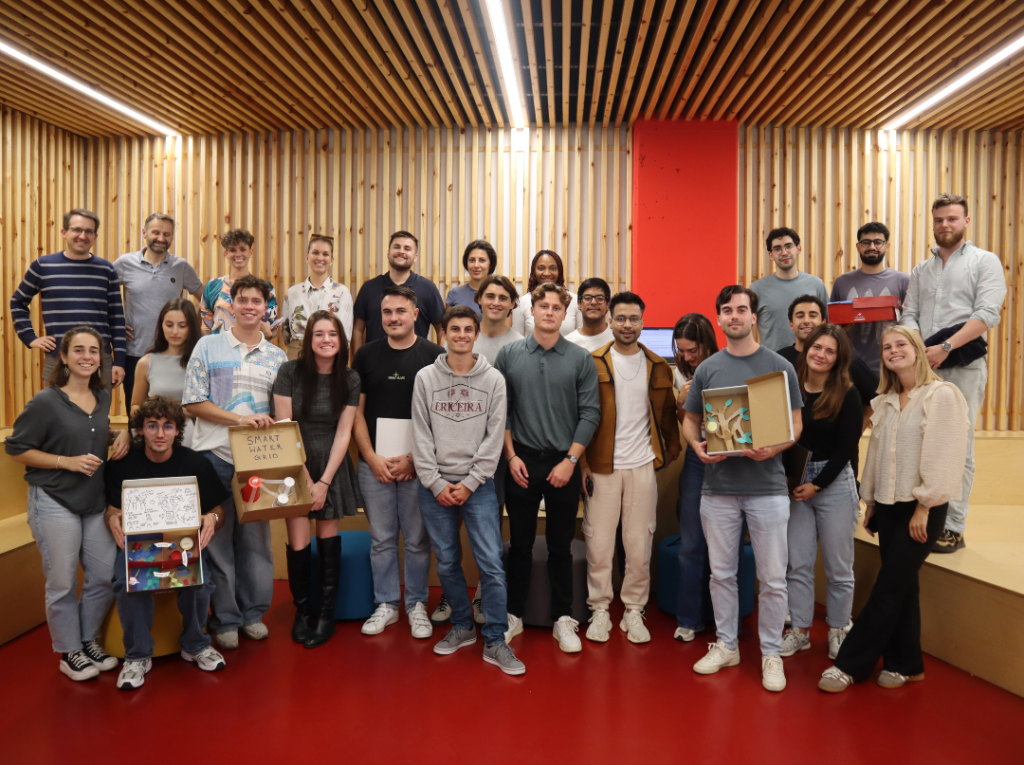
May 6, 2025
We are excited to reflect on a remarkable initiative that brought together Barcelona Executive Business School (BEBS) students in a unique collaboration with Universitat Politècnica de Catalunya (UPC), as part of a European Commission initiative aimed at fostering innovation and entrepreneurship for long-term solutions. This EU-supported Moonshot Project provided a platform for BEBS students to participate in a challenge that went beyond technical expertise—it was about creativity, vision, and ambition. The Consultancy Business Agency (CBA) played an important role in establishing the partnership and shaping the ecosystem, actively contributing to the development of projects alongside the participants from a business perspective. Their guidance ensured the ideas were not only innovative but also grounded in real-world feasibility and market readiness. Moonshot Thinking Professor Andreas Sumper, responsible for the Smart Energy and Networks research group at UPC and of the Master Energy for Smart Cities at EIT InnoEnergy, defines Moonshot Thinking as a radical approach to innovation that seeks to address major global challenges by aiming for transformative, often seemingly impossible, solutions. Rather than focusing on incremental progress, Moonshot Thinking encourages bold, visionary goals that push the boundaries of what is currently feasible. This methodology involves setting bold, ambitious goals that aim for significant societal impact. It emphasizes interdisciplinary collaboration, bringing together diverse expertise to spark creativity and discover innovative solutions. Additionally, this approach encourages risk-taking and experimentation, recognizing that uncertainty and potential failure are integral to achieving breakthroughs that can transform industries and tackle pressing challenges like climate change, energy, and infrastructure. For Professor Sumper, Moonshot Thinking is not just about solving technical problems but is deeply tied to motivating people to push beyond conventional limits and explore visionary solutions, often leading to technological and social transformation. Project Highlights The Moonshot Project involved the application of advanced tools such as the 4 Horizons Tool and the Opportunity Map to evaluate the potential of each idea. BEBS and UPC students collaborated to push the boundaries of what’s possible, generating bold “What if…?” questions and turning them into actionable solutions. The Moonshot Project yielded four innovative initiatives aimed at addressing critical global challenges: First, a satellite designed to capture solar energy offers a novel approach to harnessing renewable power from space. Second, robots for waste collection in underserved areas not only recycle materials but also reduce reliance on raw material extraction. Third, the Smart Water Grid empowers individuals to generate their own water, enabling them to sell surplus, akin to solar energy systems. Lastly, artificial trees serve as eco-friendly replacements for street electrical grids, generating energy through their leaves to provide municipalities with a zero-cost lighting solution, thereby transforming urban infrastructure. Engineers (UPC) and Business Participants (BEBS) solving long – term challenges Key Project Days October 22, 2024: Kick off the project, working closely with UPC students to brainstorm and develop their ideas. October 29, 2024: Follow-up session at UPC, further refining these concepts. December 10, 2024:A final hands-on workshop at FABLAB, where BEBS and UPC students will collaborate to create prototypes for their visionary projects The Outcome The Moonshot Project provides the students real-world experience in innovation, design thinking, and prototyping. This initiative underscored the power of collaboration, creativity, and the diverse, international student community at BEBS &UPC. Through their dedication and innovation, the students delivered solutions with the potential to create lasting change in energy, water management, and sustainable development.
Read More
May 6, 2025
Barcelona Executive Business School (BEBS) is proud to partner with some of the most prestigious universities in Spain. Our collaboration with institutions like Universidad Católica de Murcia (UCAM) and Universidad Católica de Ávila (UCAV) allows us to offer our students access to world-class education and a global network of opportunities. Recently, both UCAM and UCAV have been featured in the prestigious Forbes ranking of Spain’s best universities. The ranking recognizes the strong international focus, personalized teaching model, innovation, and commitment to quality education. Forbes highlighted the universities’ successful alumni, who hold prominent positions in various fields. What Makes These Universities Stand Out? To compile this ranking, Forbes convened an international committee of higher education experts who evaluated universities across these five key areas: Accessibility and inclusivity: The committee evaluated universities based on the availability of scholarships, financial aid, and support services for students with special needs. Job placement and internships: The committee placed significant emphasis on how well universities prepare students for the workforce and the quality of their internship programs. Alumni achievements: The success of graduates in their respective fields was another crucial factor in the evaluation. Teaching and research quality: The caliber of faculty and the strength of research programs were also considered. International outlook: Universities were assessed on their international student population, faculty, and research collaborations. Students from +130 nationalities Collaboration and partnership with UCAM and UCAV Through collaboration with esteemed Spanish universities such as Universidad Católica de Murcia and Universidad Católica de Ávila, BEBS provides its students with an unparalleled learning opportunity that blends demanding academic curriculum with hands-on, real-world experience.The steadfast dedication of these universities to quality, globalization, and student achievement is consistent with BEBS’s own principles and objectives. UCAM and UCAV have received noteworthy acknowledgement for their outstanding accomplishments. Both universities have been ranked among the best in the world by THE’s Impact Ranking, which evaluates excellent education that provides students the abilities and knowledge required to thrive in today’s global job market. Through this collaboration, BEBS students gain access to the combined knowledge and assets of these esteemed organizations, giving them a competitive advantage in the global employment market.
Read More
April 16, 2025
What can leaders and entrepreneurs learn from this holiday? Every April 23rd, the streets of Barcelona bloom with books, roses and a contagious sense of celebration. But beyond romance and tradition, there’s something else going on—something many overlook: Sant Jordi can also be a day full of inspiration for entrepreneurs, creatives and globally minded professionals. At BEBS, we invite you to see this beloved Catalan festival from a different angle—through the lens of innovation, cultural exchange, and authentic networking. Reinventing Tradition: When the Old Sparks the New The story of Sant Jordi—a brave knight, a dragon, and a magical rose—has been retold for generations. But each year, it finds new life: in graphic novels, street performances, creative merchandise, marketing campaigns, and even NFT collections inspired by the legend. One great example: “Sant Jordi in pajamas”, a virtual book fair born during the pandemic that took over Instagram and helped self-published authors and indie publishers stay connected with readers. Sometimes, innovation doesn’t mean starting from scratch—it means reimagining the familiar with fresh eyes. A Festival of Cultures: When Creativity Becomes Global Sant Jordi is deeply rooted in Catalan tradition, but its spirit is truly global. Every year, publishers release books in multiple languages, international authors sign copies for fans, and cultural institutions organize activities in Japanese, Arabic, Portuguese and more. Some community-driven events even blend literature with food, music and crafts, celebrating Barcelona’s vibrant multicultural identity. Creative ideas thrive when diverse voices share the same stage. Authentic Networking: Where Connections Just Happen Forget formal events with name tags—on Sant Jordi, connections happen organically. Writers and readers chat while waiting in line for signings. Illustrators meet authors they might collaborate with. Book lovers discover startups showcasing creative tools or digital storytelling apps. A real case: “Books that Heal”, a social project connecting therapists, indie bookstores and publishers to recommend therapeutic reading lists, began with a simple street conversation on Sant Jordi. When people gather around ideas they love, genuine networking happens naturally. A City in Creative Mode: Discovering Barcelona Through a New Lens Sant Jordi is also the perfect opportunity to explore the city in its most creative and vibrant form. From alternative book fairs in El Raval to literary cafés in Gràcia, Barcelona becomes a living map of innovation and culture. Places like Fabra i Coats or Palo Alto Market often host special Sant Jordi events that combine literature, design, tech, and entrepreneurship in one space. To walk the city during Sant Jordi is to explore the creative soul of Barcelona—one that draws students, entrepreneurs and dreamers from all over the world. What If You Could Experience the Next Sant Jordi From the Inside? At BEBS, we believe that becoming a leader doesn’t only happen in the classroom. It also happens on the streets, in creative environments, and in moments of spontaneous connection. What if your next step in business or leadership brought you to a city that celebrates culture, creativity and diversity all in one day? If you are thinking of studying in Barcelona and are looking for a business school with a modern, international, and entrepreneurial outlook... 👉 Explore our International MBA's and Postgraduate Programs in Barcelona and Online
Read More
March 20, 2025
In 2025, the words “green talent” are gaining importance in the corporate environment. We have moved from talking about “green companies” and “responsible organizations” to focusing on individuals with sustainable values. Before purchasing a product, we make sure that the brand adds value to society, considering its impact on sustainability and climate change. • Did you know that companies are now looking for people with those same values? Not only do they get paid to have them, but they actively seek them out. Green talent refers to people who possess skills, knowledge, and values that allow them to implement sustainable practices and protect the environment. These skills are critical for companies to adapt to current environmental challenges and maintain their competitiveness in a market increasingly focused on sustainability. • What skills should a green talent have? Competencies include capabilities to prevent, monitor, or reduce pollution, as well as to optimize the use of natural resources in the production of goods and services. The demand for professionals with these skills is constantly increasing due to the transition to a sustainable economy, which has led to a significant increase in job offers that require green skills. “A green talent is 76% more likely to be hired. (LinkedIn Green Skills 2024)” • What are the job opportunities in sustainability? Jobs linked to sustainability could grow by up to 40% in the coming years, especially in areas such as renewable energy, waste management and environmental consulting. The Corporate Sustainability Due Diligence Directive (CSDDD) will encourage the recruitment of partners with studies in this sector. People with master’s degrees, MBAs and other studies will stand out in the selection processes. • What opportunities to specialize? Someone studying Supply Chain or Operations Management and Logistics can take the opportunity to specialize in sustainable supply chain management, aligning with emerging regulations and helping companies meet social and environmental expectations. This directive represents both a challenge and a great professional opportunity for those interested in working in areas such as risk management, traceability, supply chain optimization, corporate sustainability and innovation. • What is the trend of the future? The trend for the coming years is to consolidate the integration of sustainability into the strategy of companies and to make progress in generating positive social and environmental impact. This is not only an obligation, but an opportunity for companies and individuals to contribute to a more sustainable future. “Green talent” is growing significantly due to the transition towards a more sustainable economy. Companies are increasingly seeking individuals with skills and values oriented towards sustainability, and these competencies are essential to face current environmental challenges. Furthermore, job opportunities in sustainability-related areas are on the rise, and specializing in these fields, such as sustainable supply chain management or environmental consulting, represents an excellent professional opportunity. In the future, the integration of sustainability into business strategies will solidify, creating both challenges and opportunities to contribute to a more sustainable future.
Read More
July 15, 2021
With 195 countries in the world, choosing where to study abroad can feel overwhelming. To make your decision easier, we’ve created our top ten countries for international students, highlighting education quality, lifestyle, cultural opportunities, and career prospects. Benefits of Studying Abroad Studying abroad is more than an academic experience; it’s a life-changing opportunity. Research consistently shows the impact: Maturity and independence: 95% of students reported increased maturity after studying abroad. Self-confidence: 96% felt more confident navigating new environments. Global perspective: 95% acknowledged lasting changes in worldview. Programs like Erasmus+ (established in 1987) illustrate the personal and social benefits. A European Commission study shows that Erasmus alumni are more likely to have international relationships, with an estimated 1 million babies born to Erasmus couples since 1987. Moreover, international experience boosts employability. Employers value multilingual candidates with cross-cultural skills and global networks essential in today’s interconnected job market. 10 Best Countries to Study Abroad 1. United Kingdom The UK hosts some of the world’s most prestigious universities. Oxford, Cambridge, and the London School of Economics consistently rank at the top. London offers a truly international environment, home to over 270 nationalities and 300 languages. Smaller cities like Manchester, Edinburgh, or Brighton also provide vibrant academic communities. Note: Brexit has slightly affected the international student environment, but UK universities remain highly attractive globally. 2. Germany Germany offers high-quality education with little to no tuition fees, making it ideal for cost-conscious students. Cities like Berlin and Hamburg are cultural hubs, offering dynamic lifestyles. Employment rates are strong (unemployment around 4.5%), though sunny weather is limited. Germany’s central location in Europe also allows easy travel across the continent. 3. Spain Spain combines culture, climate, and innovation. Barcelona and Madrid are innovation hubs, ranking among Europe’s top cities for startups. Spain is ideal for students who want to launch their careers while enjoying Mediterranean life. Spanish universities also emphasize internationalization, making it easier for students to integrate. 4. Canada Canada is renowned for high-quality universities and welcoming multiculturalism. 1 in 5 residents is foreign-born. Cities like Toronto and Vancouver offer a mix of urban life and nature, providing an excellent environment for both study and personal growth. 5. South Korea South Korea attracts students for its high-quality education and technology-driven environment. Seoul and Busan are cultural and academic hubs. While numbers fluctuated during the pandemic, the country remains a top destination for STEM and social science programs. 6. New Zealand Famous for its stunning landscapes, New Zealand combines academic quality, safety, and lifestyle. Universities like the University of Auckland and Victoria University of Wellington rank well globally. Cities like Auckland are consistently named among the world’s most liveable cities, offering a balance of study and outdoor activities. 7. Mexico Mexico is a top choice for Latin American students and international learners seeking cultural immersion and historical richness. The Universidad Nacional Autónoma de México (UNAM) is a UNESCO World Heritage site and among the top 100 universities in Latin America. Students enjoy a vibrant culture, festivals like Día de los Muertos, and renowned cuisine. 8. South Africa South Africa combines academic opportunities, economic growth, and natural beauty. Cities like Cape Town, Pretoria, and Johannesburg host top universities. The country is developing technology and innovation hubs, attracting students interested in entrepreneurship and emerging markets. 9. Singapore Singapore is a global innovation and smart-city hub. English is widely spoken, making it easy for international students to communicate and integrate. Singapore is also culturally diverse and technologically advanced, offering excellent career prospects in finance, STEM, and business fields. 10. Japan Japan is a top destination for students in STEM and technology, with a strong focus on digitization and innovation. Beyond academics, Japan offers unique cultural experiences, world-class cuisine, and renowned hospitality. Cities like Tokyo and Kyoto provide vibrant student life combined with safety and cutting-edge infrastructure. Our Recommendation: Spain While all ten countries are excellent options, Spain stands out for combining international education, career opportunities, innovation, and lifestyle. Barcelona and Madrid provide dynamic start-up environments, Mediterranean weather, and a welcoming culture for foreigners. Studying in Spain allows students to develop professionally while enjoying life to the fullest. Ready to Study Abroad? Choosing a country is just the first step. At BEBS Barcelona Executive Business School, we help students make the most of their international education, offering guidance on programs, visas, and career opportunities. 📧 Contact us at [email protected] and start planning your global journey today!
Read More
June 22, 2021
From Johannesburg to Barcelona, smart cities are becoming the norm all around the world. Just imagine that the smart city market is expected to reach USD 2036.10 billion by 2026. The concept behind that is that by combining innovation with technology it is possible to improve the lives of millions of people living and working in cities. The topic appears to be of the uttermost importance as by 2050, it is estimated that 68% of the world’s population will live in cities. Such numbers require sustainable and innovative solutions to increase the livelihood of the cosmopolitan cities we are living in. But what is a smart city? Smart Cities: Using Technology for Sustainable Development BBVA defines smart cities as “a complex and interconnected system that applies new technologies to manage everything, from the proper running of public and private transport systems, and the efficient use of power or water resources, civil protection plans, to socio-economic aspects, such as the vitality of public spaces and the commercial fabric, or the notification of incidences to visitors and citizens.” In other words, smart cities integrate technology to make our lives easier. For example, Dublin has a dedicated Smart City team that runs projects spanning from transforming public services to a Smart Tourism work program. Furthermore, in 2018, Dublin City Council launched a unique initiative called “Smart Docklands” in which innovators and entrepreneurs provide solutions to real local challenges. This ambitious program relies on partnerships with tech giants like Google, Microsoft, Deloitte, and IBM. Even more crucially, during the pandemic, several cities in the world have used technology to enable smarter approaches to COVID-19. Seoul adopted a clever solution to communicate transparently with its citizen. The city used technology and data to create dashboards providing the same information as the mayor. Smart Cities for Sustainable Development As we have seen at the beginning of ‘Smart Cities: Using Technology for Sustainable Development’, nowadays the focus is on building cities that can rely on technology to become more sustainable. It is understandable as saving our planet has become one of the major concerns of citizens. According to the biggest ever opinion poll on climate change, two-thirds of people think climate change is a “global emergency”. The poll was conducted by the UN Development Programme and surveyed 1.2 million people from 50 countries in the world. What appears clear from the poll is that people -and younger generations especially- want concrete actions to tackle one of the biggest issues of our century. Some cities are already setting the example, showing how a more sustainable future can be a reality. Helsinki has set up a project called Helsinki Metropolitan Smart & Clean Foundation in which 29 public-private partners are joining forces to develop green solutions that encompass transport, energy, construction and the waste and water sector. On the other side of the world, Singapore is planning one of the most ambitious projects ever seen. The “Tengah Project” is a forest town where technology and green spaces will live in harmony. As reported by the World Economic Forum: “Tengah will feature a 100-metre-wide ‘forest corridor’ that runs through the centre of the town. This will connect a nature reserve and a water catchment area, as well as providing safe passage for wildlife, and a recreational space for residents.” Additionally, Tengah will deploy technology to reduce energy consumption at its maximum. The benefits of going green go beyond its ethical implications, as being sustainable has a positive impact on the economy. In Barcelona, the government has managed to save around 49 million on water costs through smart IoT deployment strategies. Inclusive Smart Cities Smart cities will play a major role in helping us create a better world where sustainable development is a reality. However, sustainability means very little if it doesn’t include everyone. With this concept in mind, cities all around the world are developing projects to make cities more accessible to everyone. Medellín provides an outstanding example. Once associated with poverty and drug-related violence, it has seen a dramatic change in the last decades. Technology was crucial to achieve these results and in 2021, Medellín was awarded the title of “Innovative City of the Year.” The city council built a metro cable car system to connect poor hillside neighborhoods to commercial and industrial centers. This has reduced commutation times, enhanced mobility, promoted social equity as well as environmental sustainability and spurred private investment. The scheme, considered as a best practice, has been replicated in other cities like Rio de Janeiro, Brazil. And how not to mention the advancement made in Kolkata, India? A pioneering project has used geocoding technology to provide addresses to more than 120,000 slum residents. As a result, they were able to access government services and open bank accounts. Inclusion involves way more than socio-economic factors and encompasses people from all walks of life. For example, In London, Google awarded a $1m grant to the Royal London Society for Blind People to help vision-impaired people navigate the public transport system. What Can Go Wrong with Smart Cities As we have seen in ‘Smart Cities: Using Technology for Sustainable Development’ technology can be used to do extreme good. It can help us fighting a global pandemic or living more connected with nature. It can also be an enormous asset in creating more inclusive cities, where inequalities can be leveled up. However, smart cities are not a perfect solution and can hide some challenges. “Inclusive Smart Cities” by Deloitte reveals that, during the design, implementation and reflection phases, there are some common missteps that can mine the final results. In particular, failing to engage community members or a lack of transparency can inadvertently obtain the opposite results. The study cites cases in which smart cities initiatives deepened existing inequalities instead of resolving them. Another major concern regards data privacy. Smart cities can be a reality only with the use of data collection, but citizens are rightly concerned. Brad Smith suggests that governments and companies should work together to ensure the privacy of citizens. Will Technology Help us Create Smart Cities in Line with Sustainable Development Goals? In the not-so-distant future, we will see an increase of smart cities projects. Technology is the means to achieve more liveable and sustainable cities. It is also a golden opportunity for innovative entrepreneurs and companies to develop actions with a strong social impact. As we have seen in the case of London or Dublin, tech giants are establishing partnerships with governments, city councils and NGOs to achieve a better future while propelling economic growth. But cities are not the only actors responsible for the wellbeing of the planet and society. Private citizens can play a fundamental role too. If you are interested in understanding how, you can read more about the entrepreneurial project of Yara Lopes, one of our students of the Master in International Business Innovation. Since 2019, she is using business innovation to achieve sustainable development. In particular, her goal is to reduce consumption of single-use products by adhering to sustainable options to reduce plastic pollution.
Read More
June 4, 2021
At BEBS Barcelona Executive Business School, we often talk about the importance of innovation in business. The key is to understand how companies can adapt and thrive in modern times. Pakito Angola: Business Innovation for Sustainable Development Yara Lopes, one of our students of the Master in International Business Innovation, is already on the right path. In 2019, she founded Pakito Angola to transform the tourism and service industry. Her goal is to reduce consumption of single-use products by adhering to sustainable options to reduce plastic pollution. When asked about her motivation to run a green business, she says: “When I started Pakito Angola back in 2019, I was furious by the amount of plastic waste that was growing on the coastline. That was not only disgusting and ugly, but extremely endangering to the environment and our food source. I wanted to do something about it, in a way that could be impactful today and for the future.” Indeed she was right. With an estimated 9 million tons of plastic waste entering the oceans each year, saving our planet should be the major concern of companies. Additionally, the demand for businesses with a social impact has soared in the last years, as Millennials and Gen Z put particular emphasis on purchasing and working in organizations with ethical principles. For Yara Lopes, sustainability goes beyond being eco-friendly and aims at having a long-lasting positive impact on society. As she pointed out: “At Pakito Angola, we have a program to support women entrepreneurs. We are also proud to have a set of principles that determine the way we do business. We are committed to adhering to the UN #12 Goal Responsible consumption: this goal aims to foster eco-friendly production, reduce waste and boost recycling.” Business Innovation in Africa Sustainability and attention to social impact are per se what consumers want, but Yara Lopes went even further with her entrepreneurial project. She clearly thought about the main challenges and opportunities of running an entrepreneurial project in Africa. As she said: “Africa depends largely on the importation of finished goods and, although more than half of the Earth’s arable land – roughly 600 million hectares – is located in Africa, we rely largely on importation of food. I realized that there was an opportunity that could offer a solution to two problems: 1. Supply the local market with sustainable packaging thus ensuring that the ultimate impact to the environment is minimum; 2. Support and promote small entrepreneurs, by helping them place their products to consumers using eco-friendly packaging, making their product more attractive and differentiated.” When asked about her decision to run an entrepreneurial project in Angola, she told BEBS: “Angola has the third-fastest population growth in the continent, it is a place with great potential and opportunities in every sector. With Pakito Angola, I aim to become the largest distributor of eco packaging products to enable businesses placing their products and brands into the market.” Main Challenges of Running a Business Running these kinds of projects is rewarding behind imagination. However, as every entrepreneur knows, it is not always easy to run a business. In particular, her main problem is finding the right balance between the demand of the business and her personal life. She also stressed the importance of adapting to constant changes and remain relevant in today’s competitive environment. Finally, she does her best to managing employees, identifying gaps in their skills through open communication and address performance problems. Once again, Yara Lopes has proved she doesn’t fear challenges, but she embraces them. She is currently pursuing an online Master in International Business Innovation at BEBS to help her become a better entrepreneur. She is particularly appreciating learning more about design thinking, knowledge management and business model design, as it help her to be prepared to effectively articulate, implement and manage innovative processes and initiatives. Moreover, she enjoys being part of an international network of students and learning from professors with practical experience. In her words “I am exposed to other perspectives. We are a pool of students with different backgrounds, professionals and entrepreneurs from all over the world. It’s quite suggestive and really transformative, as we learn from each other’s experiences. I also love that the professors have practical experience as they are or were involved in business themselves.”
Read More


 Virtual campus
