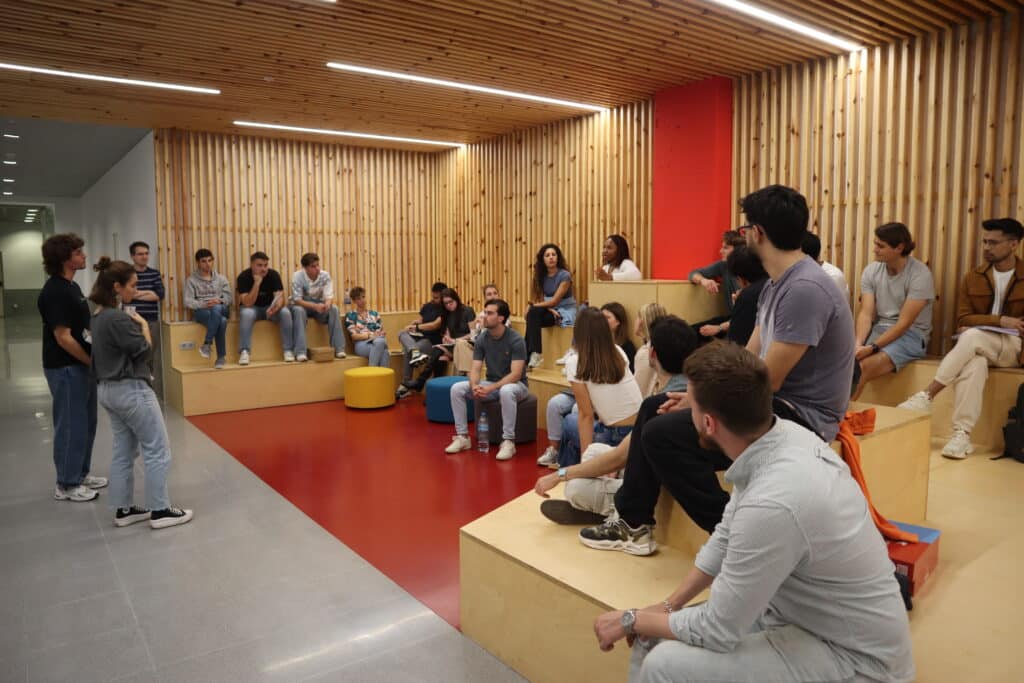
This program trains students in the most critical aspects of business management. Understand and refine your understanding of the tools needed in business creation and management through financial concepts, marketing and operations.
Acquire the skills and tools necessary to innovate and establish your own businesses with direct, practical, and effective training. Work with real-world cases, participate in company visits, and apply your newfound knowledge in practice.
A focus on the managerial, technical and strategic aspects of the supply chain. Acquire the knowledge to address relevant issues in the industrial sector and devise modern solutions for the logistics and supply chain sector.
Project managers are highly sought-after professionals, as they organize and steer ideas towards business success. This postgraduate program has an excellent teaching staff made up of renowned project managers.
Human resources are usually one of the most complex areas for companies to manage. The postgraduate in Leadership and Talent Management trains students in the skills of managing people and resources related to human capital.
We prepare leaders and managers in the tourism and hospitality sector with the most relevant management training in just 6 months. This program targets key professionals; 1 out of every 10 jobs worldwide directly or indirectly relates to the sector.
This master’s program teaches you the skills to analyze an organization’s operational performance in terms of production, distribution and international logistics. It provides you with the necessary tools and techniques to become an effective manager.
This master’s program will equip you to become a professional specializing in leading change initiatives aimed at boosting productivity and employee satisfaction within your organization. You will learn the latest practices and HR-specific analytics.
This MBA is dual accredited. Gain practical and up-to-date training in a field that has changed significantly over the last decade with the MBA in International e-Supply Chain Management from BEBS. There’s a demand for professionals who can effectively manage the opportunities presented by emerging technologies
Human Resources (HR) plays a strategic role in every business. This MBA from BEBS empowers you to advance in your professional career and emerge as a leader in human resources by equipping you with the essential skills.
The MBA in International Tourism and Hospitality Management at BEBS offers a forward-thinking approach that goes beyond traditional programs. Students not only gain insights into tourism and hospitality management but also delve into business management from a more innovative and multidisciplinary perspective.
Gain the skills to effectively execute international projects, transforming ideas into tangible outcomes with the MBA in International Project Management from BEBS. Project management is essential for achieving measurable results and plays a critical role in business operations.
This MBA is dual-accredited and provides practical, up-to-date training in a field that has evolved significantly over the past decade. There’s a demand for professionals who can effectively manage the opportunities presented by emerging technologies.
Get to understand today’s global business, with a focus on managing business innovation. Gain the skills and tools to innovate and create, at your current position or in your own business.
Study BEBS Postgraduate in Project Management and take advantage of our new Scholarship Plan
Barcelona Executive Business School offers high-level training programmes with a practical model focused on resolving day-to-day issues in the classroom. The Postgraduate in Project Management is a great example of this study methodology.
Thanks to a team of professors who are active professionals in the field of project management, students get an accurate picture of the current demands and trends in the sector. They have the opportunity to train with professionals with years of experience and knowledge who provide them with real case scenarios.
This postgraduate course in project management is an excellent opportunity to acquire practical and up-to-date training based on the real business world.
If you are thinking about enrolling in this programme, now is the perfect opportunity. BEBS has launched a new Scholarship Scheme for the Postgraduate in Project Management which can mean up to 20% discount on the tuition fee. The scholarship is available to any new student who wants to enrol in BEBS and who applies before 31 December 2022, either in on campus or online modality.
Become a successful business planner
Developing project management skills is essential for any professional responsible for managing teams, large or small. Managers need to make quick decisions in unpredictable scenarios and project management skills allow them to define and create good plans and execute them correctly.
This postgraduate course in project management creates professionals who are sufficiently skilled to perform in today’s hyper-competitive and globalised environments. Using this knowledge, students become effective facilitators of the objectives of any project that may come their way.
The programme is based on a practical methodology focused on fostering and encouraging teamwork, problem solving, critical thinking and collaboration.
Who is this programme for?
BEBS Postgraduate in Project Management is a programme designed for professionals who are developing their careers as project managers and want to improve their knowledge and skills in the area in order to advance their careers.
In this postgraduate course you can find different types of profiles. The contents of the programme are useful for company directors or managers who want to update their project management skills with the latest trends in the field, but also for recent graduates who are trying to start their way through new career opportunities in this strategic sector.
Since the position of project manager is not closed to any industry, BEBS Postgraduate in Project Management is a great option for professionals from any sector who work directly with projects.
Upon completion of this programme, students will be able to work in positions such as Project Manager, Program Manager, Delivery Manager or Project Officer Manager. Students are trained with a global, integrated and strategic vision of any company.
How is this achieved?
As mentioned above, the key element of this programme is that the lecturers are working professionals with years of experience as project managers. The classes are not just about the theoretical framework, but how it is applied in today’s business scenario.
The professors teach through their own learning and experiences. Sharing that reality with students to give them a much more realistic picture of what they will encounter once they finish the programme and start the next phase of their professional careers.
Each module of the BEBS Postgraduate in Project Management has a case study. The lecturers bring to the classroom real examples of situations faced by companies today. After learning about the context, students are challenged to find a solution to these dilemmas and share it with the rest of their classmates.
What better way to learn how to act at crucial moments than to actually do it? This practical mindset is one of the core values of BEBS and will prepare you to face any challenge.
During the Postgraduate in Project Management, you will share the classroom with professionals from all continents. As a result, you will learn how project management is approached around the world and use this knowledge for your international career.
It is an excellent opportunity to foster new friendships and career opportunities at the same time. This programme can be your first step towards a new career that will take you much further than you ever imagined.
Learn the fundamentals of project management and entrepreneurship
You will start the Postgraduate in Project Management course with the module ‘Entrepreneurship & Innovation’, where you will learn essential ideas to develop an entrepreneurial mindset and become a disruptive innovator. The classes will train you on how to build a business plan from scratch, the business model of a start-up or the financial evaluation of new projects.
In the ‘Project Management Fundamentals’ module you will learn the basics of project management: fundamental concepts, different approaches, budget planning and control, initial financial decisions needed to launch a project and stakeholder analysis, among other important aspects.
And in the module ‘Project Planning’ you will be trained in the planning processes of the Project Management Body of Knowledge. Commonly known as PMBOK, this is a collection of processes, best practices and guidelines that are considered standard in the field of project management.
Develop your project management skills
Once you have completed these first training blocks, the ‘Project Execution’ module is designed to instruct you in the process of executing any project, such as the organisational aspects that need to be taken into account, the management skills on site, or the strategies and negotiation techniques that are needed.
The ‘Critical Chain Project Management’ module teaches students the planning and management method that analyses the resources required to perform the tasks necessary to execute any project. People, equipment, resources, physical spaces, etc. At the end of this course, students will be able to perfectly manage this basic chain.
As a project manager, you will also have to acquire your own working method. That is why the last module of this postgraduate course is ‘Project Management Tools and Techniques’. If you haven’t heard of techniques such as Agile or Scrum, you will learn about them here. The same with Capability Maturity Model Integration or CMMI, a model designed to update and evaluate the development of systems.
Now that you know most of the details about the Postgraduate in Project Management and the new Scholarship Plan, do you want to know more about the programme? You can find all the details about this postgraduate on our website, contact our team of Student Advisors and get all the advice you need.
Henkel visit: Fostering Innovation and Career Opportunities
BEBS was honored to host Audrey Leibfried, Henkel’s Global Purchasing Manager, Thermal Management & Metals, for an engaging session that combined insights into Henkel’s innovative business strategies and exciting recruitment opportunities for our students.
This initiative was a collaborative effort with Consultancy Business Agency (CBA), who played a key role in coordinating the session and providing inputs in today’s inovation challenges.
Henkel: A Global Leader
Henkel, with 147 years of innovation, is a global leader in adhesive technologies and consumer goods, spanning laundry care, home care, and beauty products. Their impact is immense: every second, 20 people use Henkel’s Schwarzkopf hair products, and 25 billion laundry loads are cleaned annually with their detergents. Committed to sustainability, Henkel has reduced CO2 emissions by 61% and incorporates 19% recycled plastic into its consumer packaging.
Building the Bridge Between Industry and Academia
At BEBS, we pride ourselves on creating platforms where students can engage directly with industry leaders: Henkel’s visit to BEBS showcased how academic institutions and global leaders can work together to drive meaningful change. Students gained firsthand insights into Henkel’s sustainable practices and cutting-edge technologies while exploring career opportunities within a company recognized for its innovation.
BEBS Students took part in a groundbreaking Moonshot Project
We are excited to reflect on a remarkable initiative that brought together Barcelona Executive Business School (BEBS) students in a unique collaboration withUniversitat Politècnica de Catalunya (UPC), as part of a European Commission initiative aimed at fostering innovation and entrepreneurship for long-term solutions.
This EU-supported Moonshot Project provided a platform for BEBS students to participate in a challenge that went beyond technical expertise—it was about creativity, vision, and ambition.
The Consultancy Business Agency (CBA) played an important role in establishing the partnership and shaping the ecosystem, actively contributing to the development of projects alongside the participants from a business perspective. Their guidance ensured the ideas were not only innovative but also grounded in real-world feasibility and market readiness.
Moonshot Thinking
Professor Andreas Sumper, responsible for the Smart Energy and Networks research group at UPC and of the Master Energy for Smart Cities at EIT InnoEnergy, defines Moonshot Thinking as a radical approach to innovation that seeks to address major global challenges by aiming for transformative, often seemingly impossible, solutions. Rather than focusing on incremental progress, Moonshot Thinking encourages bold, visionary goals that push the boundaries of what is currently feasible.
This methodology involves setting bold, ambitious goals that aim for significant societal impact. It emphasizes interdisciplinary collaboration, bringing together diverse expertise to spark creativity and discover innovative solutions. Additionally, this approach encourages risk-taking and experimentation, recognizing that uncertainty and potential failure are integral to achieving breakthroughs that can transform industries and tackle pressing challenges like climate change, energy, and infrastructure.
For Professor Sumper, Moonshot Thinking is not just about solving technical problems but is deeply tied to motivating people to push beyond conventional limits and explore visionary solutions, often leading to technological and social transformation.
Project Highlights
The Moonshot Project involved the application of advanced tools such as the 4 Horizons Tool and the Opportunity Map to evaluate the potential of each idea. BEBS and UPC students collaborated to push the boundaries of what’s possible, generating bold “What if…?” questions and turning them into actionable solutions. The Moonshot Project yielded four innovative initiatives aimed at addressing critical global challenges:
First, a satellite designed to capture solar energy offers a novel approach to harnessing renewable power from space. Second, robots for waste collection in underserved areas not only recycle materials but also reduce reliance on raw material extraction. Third, the Smart Water Grid empowers individuals to generate their own water, enabling them to sell surplus, akin to solar energy systems. Lastly, artificial trees serve as eco-friendly replacements for street electrical grids, generating energy through their leaves to provide municipalities with a zero-cost lighting solution, thereby transforming urban infrastructure.
Engineers (UPC) and Business Participants (BEBS) solving long – term challenges
Key Project Days
October 22, 2024: Kick off the project, working closely with UPC students to brainstorm and develop their ideas.
October 29, 2024: Follow-up session at UPC, further refining these concepts.
December 10, 2024:A final hands-on workshop at FABLAB, where BEBS and UPC students will collaborate to create prototypes for their visionary projects
The Outcome
The Moonshot Project provides the students real-world experience in innovation, design thinking, and prototyping. This initiative underscored the power of collaboration, creativity, and the diverse, international student community at BEBS &UPC. Through their dedication and innovation, the students delivered solutions with the potential to create lasting change in energy, water management, and sustainable development.
Sant Jordi: A Day of Culture, Creativity and Unexpected Connections
What can leaders and entrepreneurs learn from this holiday?
Every April 23rd, the streets of Barcelona bloom with books, roses and a contagious sense of celebration. But beyond romance and tradition, there’s something else going on—something many overlook:
Sant Jordi can also be a day full of inspiration for entrepreneurs, creatives and globally minded professionals.
At BEBS, we invite you to see this beloved Catalan festival from a different angle—through the lens of innovation, cultural exchange, and authentic networking.
Reinventing Tradition: When the Old Sparks the New
The story of Sant Jordi—a brave knight, a dragon, and a magical rose—has been retold for generations. But each year, it finds new life: in graphic novels, street performances, creative merchandise, marketing campaigns, and even NFT collections inspired by the legend.
One great example: “Sant Jordi in pajamas”, a virtual book fair born during the pandemic that took over Instagram and helped self-published authors and indie publishers stay connected with readers.
Sometimes, innovation doesn’t mean starting from scratch—it means reimagining the familiar with fresh eyes.
A Festival of Cultures: When Creativity Becomes Global
Sant Jordi is deeply rooted in Catalan tradition, but its spirit is truly global. Every year, publishers release books in multiple languages, international authors sign copies for fans, and cultural institutions organize activities in Japanese, Arabic, Portuguese and more.
Some community-driven events even blend literature with food, music and crafts, celebrating Barcelona’s vibrant multicultural identity.
Creative ideas thrive when diverse voices share the same stage.
Authentic Networking: Where Connections Just Happen
Forget formal events with name tags—on Sant Jordi, connections happen organically. Writers and readers chat while waiting in line for signings. Illustrators meet authors they might collaborate with. Book lovers discover startups showcasing creative tools or digital storytelling apps.
A real case: “Books that Heal”, a social project connecting therapists, indie bookstores and publishers to recommend therapeutic reading lists, began with a simple street conversation on Sant Jordi.
When people gather around ideas they love, genuine networking happens naturally.
A City in Creative Mode: Discovering Barcelona Through a New Lens
Sant Jordi is also the perfect opportunity to explore the city in its most creative and vibrant form. From alternative book fairs in El Raval to literary cafés in Gràcia, Barcelona becomes a living map of innovation and culture.
Places like Fabra i Coats or Palo Alto Market often host special Sant Jordi events that combine literature, design, tech, and entrepreneurship in one space.
To walk the city during Sant Jordi is to explore the creative soul of Barcelona—one that draws students, entrepreneurs and dreamers from all over the world.
What If You Could Experience the Next Sant Jordi From the Inside?
At BEBS, we believe that becoming a leader doesn’t only happen in the classroom. It also happens on the streets, in creative environments, and in moments of spontaneous connection.
What if your next step in business or leadership brought you to a city that celebrates culture, creativity and diversity all in one day?
If you are thinking of studying in Barcelona and are looking for a business school with a modern, international, and entrepreneurial outlook…
What do Supply Chain Managers do? How Much do They Earn?
Since the rolling of vaccines for COVID-19, everyone has discovered that a good Supply Chain Management (SCM) marks the difference between failing or succeeding in a globalized world. In the last months, even people who are not into logistics have heard multiple times about the importance of supply chain. Despite this, not many people have clear in their minds what supply chain managers do. For this, we have created a guide to help you and maybe you will discover a possible career to pursue.
But first, let’s dig in some data. COVID-19 has created enormous problems for different industries that are now struggling to recover. Well, this does not apply to the supply chain industry. Data says that, regardless of the pandemic, the global SCM market is set to grow by 11.2% from 2020 to 2027.
What do supply chain managers do? How much do they earn?
As described in TalentLyft “Supply Chain Managers are responsible for overseeing and managing company’s overall supply chain and logistics strategy and operations in order to maximize the process efficiency and productivity. Additionally, they play a crucial role in developing and maintaining good relationships with vendors and distributors.”
In other words, as a supply chain manager, you will have the opportunity to travel and make meaningful connections that could benefit the company. You will be based in an office for the major part of the time. However, from time to time, you will be required to visit warehouses, suppliers and customers, with some of them located in a different city or country. Sounds exciting, right?
Apart from the technical skills, you will have to develop different soft skills to excel at this job. Communication, organizational and diplomacy skills are without any shade of doubt the most important qualities you should have. For example, communication and diplomacy will help you creating and fostering positive connections with vendors and distributors. If you think you do not have those skills, don’t worry, you are still in time to work on them.
The hard work you will put into developing the hard and soft skills necessary to thrive in this career will be paid back. A Supply Chain Manager in Spain usually earns a higher-than-average salary of €47,053 per year. Of course, the salary will depend on your experience. Nevertheless, even early career Supply Chain Managers can not complain at all, as they usually earn €34,412 per year. Once they have around 5-9 years of experience, the pay rise to an average of €43,718 . Finally, an experienced Supply Chain Manager with 10-19 years of experience earns an average of €57,288.
2 Tips to start your career in Supply Chain Management (SCM)
It is often difficult to understand the best ways to start a career in the supply chain industry. In our professional opinion, you should focus on two main things.
Education
First of all, make sure you receive a proper education to train you on a theoretical and practical level. Our MBA in International e-Supply Chain Managementdoes precisely this. As you will discover later on in this article, we know that technology plays a crucial role in this field. We will give you the right tools to use and apply technology consciously in your professional life. Moreover, you will have the opportunity to pursue a double accredited MBA that will increase your chances to be hired.
Trends
The second thing you should always have in mind, learning never ends. Even when you will finish your higher education, you should look at recent trends in SCM to keep yourself informed. This is because the supply chain industry, like many others, is in constant evolution. Therefore, professionals should actively look forward to new ways to create added value to the company they are working for, introducing the necessary elements to keep organizations modern. In the next chapter, we have analyzed for you the three maintrends that will help you kick-start your career.
The term “green supply chain” is defined as “the concept of integrating sustainable environmental processes into the traditional supply chain. This can include processes such as product design, material sourcing and selection, manufacturing and production, operation and end-of-life management.”
Every company should seriously consider becoming more sustainable in its supply chain management, as it has numerous benefits. It has a clear positive impact on how an organization is perceived by consumers. This, in turn, will increase sales, as people are more likely to support and purchase from a green company. Moreover, a sustainable approach to the supply chain means a reduction in costs, as it will lead to lower waste-disposal and training costs.
– Data Analysis
Data Analysis has permeated every industry, including the supply chain. Just imagine that41% of supply chain managers reported having data analysis as a priority. It is understandable, as supply chains generate a massive amount of data that can be properly understood and categorized only with data analysis.
Analytics will help companies make better decisions based on trusted data. This will help organizations achieve their goals as they will be able to better understand risks, prepare for the future, better understand the clients’ needs.
Moreover, as pointed out by IBM, the worldwide famous multinational technology company: “A recent Gartner survey revealed that 29% of surveyed organizations said they have achieved high levels of ROI by using analytics, compared with only 4% that achieved no ROI.”
-5g And IoT
As with data analysis, technology can be our best ally if we only learn how to use it.
When it comes to supply chain management, the right implementation of technology can play a fundamental role in making the process easier and more precise.
According to Johan Jemdahl “The full potential of IoT (Internet of Things) to track inventory will finally be unleashed under 5G. Cargo can be fitted with inexpensive sensors that use very little power, and track goods from the factory floor, through the shipping process, to the warehouse, all the way to store shelves, creating a trusted record of an item’s journey. One of the most disruptive uses for 5G networks is driverless transportation. 5G is likely to make this possibility a reality, which will have a huge impact on the logistics industry.”
Kick-start your Career
As you have seen inWhat do supply chain managers do? How much do they earn?, the SCM industry is full of rewarding opportunities. You will have the chance to travel to manage and supervise the different steps of supply chain management. Moreover, you will earn a higher-than-average salary and you will have no problems finding a job.
To start a career in one of the most demanded professions of the future, you will need to be open to invest in your education and never stop learning. Remember, for a successful career in SCM, you will need to keep yourself updated with the latest trends in the field.
We have provided you with the basics to kick-start your career. Now it is your turn to act. At BEBS, you will be able to choose to pursue your MBA online or on campus. Stop making excuses and get in touch with us at [email protected].




















 Virtual campus